Becoming “mindful” has entered the American mainstream as evidenced by the countless books and articles devoted to the topic. At its most basic, being mindful is being consciously aware of something in the present moment and accepting that awareness without judging it. Many claim that being mindful results in a variety of benefits. It apparently is good for our bodies, possibly boosting our immune system, and good for our mind, by helping to reduce stress and depression, and it can even tune out distractions and help us better focus. But can mindfulness possibly play a role in helping to treat Parkinson’s? In trying to answer this question, we came across a clinical study written by Barbara Picket, MD, M.P.H. and researchers at the University of Amtwerp in Belgium called Mindfulness Training among Individuals with Parkinson’s Disease: Neurobehavioral Effects.
For this study, persons with Parkinson’s took part in a study in which half of the group were assigned to a mindfulness-based group and the other half to a usual care group. Those involved in the mindfulness group had weekly sessions that included things like yoga and sitting medication. They were also instructed how to practice mindfulness at home. At the start of the study, all participants had a MRI of their brain. At the end of the study, each had another MRI to see if the MRI recorded any changes in their brains. Interestingly, for the individuals in the mindfulness group, there were changes that included an increase in grey matter density in the left and right hippocampus and other areas of the brain that was not seen in the participants in the other group.
The study concluded that “Even with advances in symptomatic treatment, there is a need for adjunct person-centered therapeutic approaches to help improve the well-being of people who are faced by this disease in daily life. … Mindfulness training, as taught by qualified and experienced teachers, may offer a more participatory medicine, empowering the individual by engagement to learn how to strengthen internal resources to help cope with chronic disease. Mindfulness training may help to restore some degree of self-determination in the experience of living with PD. This is in line with person-centered research that employs scientific methods that are holistic, integrated, and transdisciplinary.”
It is also noted that caution must be used in interpreting their results because of acknowledged limitations of the study. Even so, the study may demonstrate that a program of mindfulness training for people living with Parkinson’s can be beneficial. The study is available under the Creative Commons Attribution License. You can read it at Parkinson’s Disease, a peer-reviewed, open access journal, at http://dx.doi.org/10.1155/2015/816404.
If you’d like to try adding mindfulness to your day, there are several resources that will help get you started. Mindful.org has an article called 11 Steps Toward Daily Mindfulness . Its goal is to help you avoid going down the “same old mental ruts” and to instead become aware of where your attention is and “deliberately changing the focus of attention.”
In this Ted Talk, mindfulness expert Andy Puddicombe describes the power of refreshing your mid for 10 minutes a day.
In this TED talk, Pico Iyer talks about the insight that comes with taking the time for stillness.
Do you have Parkinson’s and practice mindfulness? Please let us hear how it is working for you!
– Margaret Tuchman and Gloria Hansen, The Parkinson Alliance
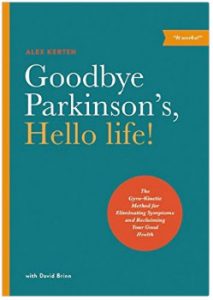
Recently we came across an article entitled, Israeli healer treats Parkinson’s through talk and dance. It’s the story of how Michael Wiese, a publisher who was diagnosed with Parkinson’s, came to meet Alex Kerten, the founder and director of the Gyro-Kinetics Center in Herzliya, Israel. Wiese was so impressed with how Kerten helped him (along with thousands of others with Parkinson’s) that he told Kerten he would like to publish a book describing his technique. Wiese introduced Kerten to David Brinn, the managing editor of The Jerusalem Post, who became the book’s co-author, and Goodbye Parkinson’s, Hello Life was born.
Goodbye Parkinson’s, Hello Life is a 203 page book with the goal of reducing Parkinson’s symptoms by lowering anxiety through mindfulness and creating motion in the body through music, movement, and rhythm. Kerten explains that anxiety is often rooted long before a diagnose of Parkinson’s, and he addresses how to recognize it and change the negative scripts that might be playing in your mind. “Our biochemistry and our psychology start to change as we learn to control our way of thinking.” Movement is through a series of exercises that focus on breathing, movement, self-massage, conducting, and improvised dancing. By synchronizing your thoughts and actions, you can become a “Parkinson’s warrior” — a person who is unafraid to change their story and feel good again.
Yes, it takes work to both incorporate mindfulness and exercise into your day. Yet the benefits are clearly there. And as he points out, the book is not a replacement to your movement disorder specialist or medications. Instead it is a complement to them. Kerten recognizes that people with Parkinson’s have good days and bad days. He suggests that you use the book as a guide or to “take from it whatever you need to help you cope and overcome whatever difficulties you are facing on a particular day.” He concludes with “Believe in your commitment, visualize it, dream it, expect it, and bring more and more of what you want into your life.” Become a Parkinson’s warrior.
– Margaret Tuchman and Gloria Hansen, The Parkinson Alliance
by guest blogger John Cornicello, a Seattle-based portrait photographer Cornicello Photography and a person with Parkinson’s
It all started a few years ago. I was working for a well-known software company. My job had me at a computer, typing, most of the day. I started noticing some “issues.” My left hand was becoming less accurate — DOuble-caps, repeating letters, things like that. I also noticed that my left arm was pulling in towards my body when at rest and it didn’t move/swing as I walked. My piano playing had been actually getting better for a few years, then all of a sudden it started a dive, too.
My first thought was that I suffered some sort of mild stroke. I got a referral to a neurologist, had an MRI, and things looked good. He had me do some basic movements. Then, as he observed me, he suggested that I might have Parkinson’s. I had no tremors. Just the stiff left arm and some cogwheel type of movement in my left wrist.
I had already been taking Ropinerole for restless leg, so we didn’t change anything there. My diet has never been that great, so my wife and I tried to go radical (for me) for a few months with no sugar, carbs, or gluten. I did lose about 20 lbs very quickly. However, I was starting to get some tremors in my left hand. After three months, I went back to dairy and gluten but have managed to keep away from sugared soft drinks.
Concurrently with all of this I had been photographing for a circus school here in Seattle. SANCA is the School of Acrobatics and New Circus Arts, one of the largest such schools in the world. I became friends with the owners and at the end of a benefit show in February 2015 I casually mentioned that I had Parkinson’s and asked Jo Montgomery if she had ever worked with Parkinson’s patients. She said she had not, but that I should stop in at the school next Monday. And I’ve been there just about every Monday, since.
I was 57 and pretty sedentary when I started this. Jo started me up slowly with stretching exercises. And then gradually started asking me to try more activities. My initial reaction to most of these has been, “You want me to do what? OK, I can bounce on a trampoline and do some jumping jack type of movements, But now you want me to do a seat drop? And then come back to a standing position?” I dreaded the trampoline for about 2 weeks.
Then it clicked and has become a favorite part of our routine. Next came walking on a balance beam. About 3″ wide and 6″ off the ground. More difficult than expected, but not so bad. I could do that one. Until one day she suggested a tight wire instead. A steel cable about 1/2″ or so wide. Barefoot, Jo would be holding one wrist as I walked back and forth across the wire. I never measured it, but I’m guessing it is a 12 foot distance. Amazingly I did it. And I enjoyed it.
All of this has built good core strength and improved my confidence.
So next came juggling. I’ve never been able to juggle. Maybe it is from lack of discipline and practice.
But I try. Balls, clubs, rings. On my own, I’m really bad. But I found that I can toss 2, 3, or even 5 rings with another person. I believe this routine is helping to make new brain connections that might help with Parkinson’s.
Then back to stretching. When I first started I couldn’t move my left shoulder. I would hold my left arm out to the side and grab a bar and tell it to move up/down and forward/back. And nothing would happen. I could tell my right shoulder to make all sorts of movements and it would. But the left shoulder would just sit there, completely ignoring my commands. I don’t know if is the medications (I started seeing a movement specialist in June 2015, and started Carbo/Leva in September), or all the other exercises, or a combination, but my left shoulder is finally starting to follow instructions and move around in circles when I want it to.
We also do some strength training by doing pull-ups on a trapeze bar and an exercise where I grab a bar above my head against a wall and pull my knees up to my chest 20 times.
Outside of circus school I have set up my home “triathlon” routine where I do a 30 minute routine that consists of a mile on a treadmill, then spin at 80-90 pedal rpm on a stationary bicycle for the balance of the 30 minutes. Then I take a shower.
All of this has helped me maintain a healthy and positive attitude. I consider myself lucky that my tremors are mostly mild and confined to my left hand so they don’t affect my photography. Yes, I’ve started using a tripod more often, but not all the time. I do worry that my left hand tremor might be a distraction to my subjects if my hand starts banging against my tripod. But I do explain the situation if that happens and all seems good.
This past week I found out that one of the members of SANCA’s board of directors has been diagnosed with Parkinson’s and she has joined in on the Monday class. Our first try at juggling rings with each other went remarkably well.
Some days I wonder if I should be more concerned with my Parkinson’s. But so far I have managed to maintain a very upbeat attitude. I really look forward to both the SANCA and the home workouts. And I am somewhat amazed as I learn about more and more friends and colleagues who have some sort of tremors, be they essential tremors or Parkinson’s. This makes me have hope that more people will be learning about these issues leading to more research and the possibility of cures and even prevention. In the meantime, I am now starting to think about boxing lessons with a program like Rock Steady Boxing.
Thank you, John, for sharing your story with my assistant and blogging partner, Gloria Hansen. You are very creative and we applaud your unconventional approach to exercise, which we know is the best medicine for Parkinson’s. — Margaret Tuchman, President of The Parkinson Alliance
By Margaret Tuchman, President of The Parkinson Alliance and a person with Parkinson’s disease formally diagnosed over 35 years ago.
I am a regular watcher of TED, a platform for sharing ideas and sparking conversation. Recently I watched two talks that left me hopeful and grateful.
The first is from Jocelyn Bloch, a “functional neurosurgeon” who works to improve neurological function through different surgical strategies. Her talk is entitled, “The brain may be able to repair itself — with help.” When I started watching, I was surprised to hear her mention deep brain stimulation and how it has improved neurological function and thus the destiny of people with Parkinson’s. Her dream, however, is to go beyond the neuromodulation that DBS offers and into the realm of neuro-repair. Her journey started some 15 years ago when she worked in an emergency room as a chief resident and treated patients with severe head trauma. It was from that experience that she and a colleague began experimenting with cells from pieces of brains. These experiments are proving that, with a little help, it just may be possible for the brain to one day repair itself. It’s a fascinating under twelve minute talk that I encourage you to view.
The second is from monk and interfaith scholar David Steindle-Rast. His talk entitled, “Want to be happy? Be grateful,” suggests that happiness is born from gratitude. He tells us that the most valuable thing we are given is this moment, and that every moment is a new gift, and we get this gift over and over again. He gently encourages us to remember what we were told as children: Stop. Look. Go. By slowing down, looking, and understanding where you are are, he describes how we can learn to find gratitude in the ordinary and from that gratitude a sense of happiness in the now.
As a person with Parkinson’s, I found this 15 minute talk an excellent pick-me-up.
You can view it below.
What TED talks have you enjoyed? I look forward to hearing from you.