by The Parkinson Alliance | Feb 24, 2016 | Computer Use & PD
By Margaret Tuchman, President of The Parkinson Alliance
Having Parkinson’s and using a computer is often a struggle. As mentioned in Part One (which appears below this post), changing some computer operating system settings were a big help to me. Here are a few more changes that I made which continue to make my computer experience much easier.
Removing the magic from the mouse. Newer Macintosh computers offer some options for pointing devices, including the “Magic Mouse” and the “Magic Trackpad.” My purchase included the mouse. While people with more dexterity may love the many features of the multi-touch mouse, I found they made my computer experience a near nightmare! One wrong shake of my finger and my open windows flew off my screen! My best solution was to turn off the magic.
To do so, go to Finder > System Preferences > Mouse. In the mouse options, click the More Gestures tab. Turn off swipe between pages. Turn off swipe between full-screen apps. Turn off Mission Control. Under Point & Click, turn on scroll direction: natural. Turn on secondary click (I selected click on the right side, you may want to change this to left if you are left handed). Turn off smart zoom. You’ll see under this option that you can also control the tracking speed of the mouse.

I later tried the Magic Trackpad, thinking it might work better for me. It did not. Even with turning off its “magic” (you can find the options under Finder > System Preferences > Trackpad), I found the shape of the mouse was easier for me to grip and move.
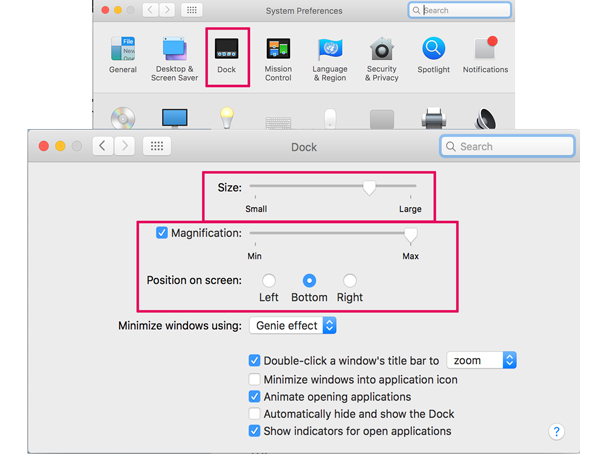
Enlarging dock icons and changing their position. I found making the dock icons larger and positioning them at the bottom of the screen was helpful. To do so, go to Finder > System Preferences > Dock. From there you can drag the slider to make your dock icons larger (or smaller). I set the magnification to maximum. While in the dock preferences, notice some of your other options. For example, you might like your dock icons on the left or right.
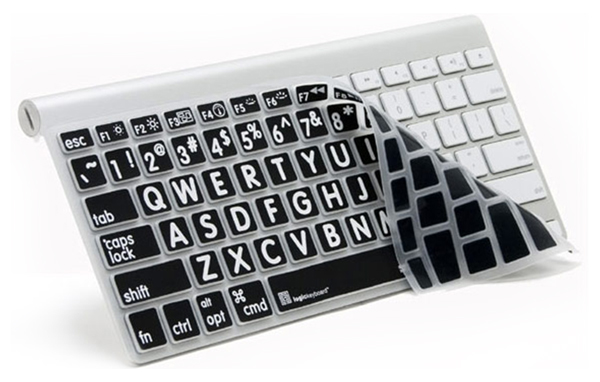
While not a setting, another thing that helped me a great deal was adding a large print keyboard cover to my keyboard. It’s an inexpensive add-on that greatly improves the readability of the keyboard. The image below is the cover I use, but there are others available. If you think this might help you, search for “large type keyboard cover” in your favorite search engine to find a cover to fit your keyboard.
Additional options. If you’re using Windows, there are similar adjustments you can make. In this article from Microsoft, you can find directions for using their Ease of Access control panel. More accessibility information from Microsoft is here.
Additionally, Apple and Microsoft both have retail stores with workers eager to answer your questions. It’s often very helpful to set up an appointment and work one to one. To get more information or set up an appointment with a person at Apple’s Genius Bar, go here. To get more information or set up an appointment with a person at Microsoft’s Answer Desk, go here.
Everyone’s Parkinson’s symptoms can affect them differently. These changes, while not at all time consuming to make, immensely improved my ability to continue using my computer. I’d like to hear from you. How does Parkinson’s affect your ability to use your computer? What changes have you made to make your computer experience a better one?
by The Parkinson Alliance | Feb 17, 2016 | Computer Use & PD
By Margaret Tuchman, President of The Parkinson Alliance
When I upgraded my older Macintosh with a new 27″ beautiful iMac, I was in for a big surprise. While the display was gorgeous, I suddenly realized everything I saw was tiny! The pointer was so small that I couldn’t find it. The menus seemed to overlap. When I touched my new mouse, open windows started flying everywhere. I couldn’t find the scroll bars. I suddenly found myself wondering if my Parkinson’s was going to stop me from using my computer.
Luckily for me, the person who helped me set up my new computer immediately saw my panic. She then began making adjustments, turning features on and off, which resulted in me having a much better computer experience. What follows are some of the changes made that saved me, and maybe will save you, some enormous frustration.
Changing the default size of the pointer/cursor, reducing transparency, and adjusting contrast. All of these modifications are made in the Display area of the Accessibility panel. To access it, go to Finder > System Preferences > Accessibility > Display. You can see my settings below, which include a larger cursor size, reduce transparency turned on, and the display contrast tweaked. While in that area, you may want to experiment with other settings to see if they made a positive difference.

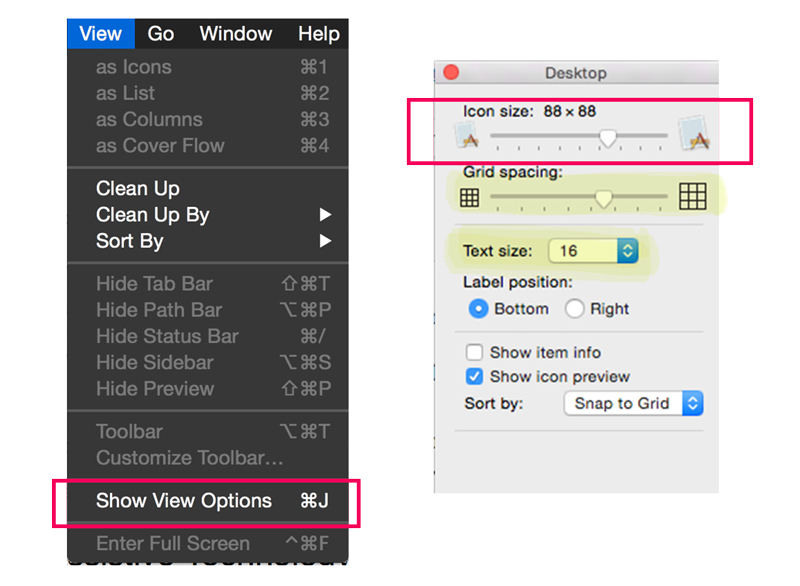
Larger icons. In the Finder, select View > Show View Options. Or, from the Finder select Command-J. Use the slider near the icon size to adjust the size of the icons. You can see my other settings below that include a large grid spacing and larger text under my icons.
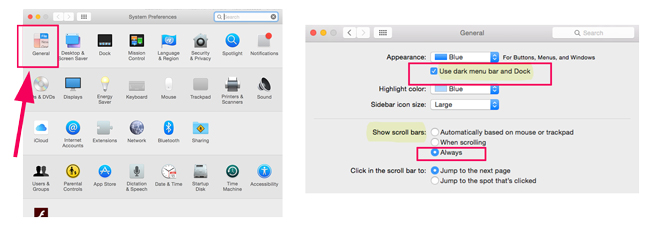
Dark menu background and showing scroll bars. Both are great options that are easy to miss. To turn them on, go to Finder > System Preferences > General. Then, click in the box to turn on “Use dark menu bar and Dock” and click “Always” to show scroll bars.
In part two, I will share some more settings that helped me. I will also give some resources for people using the Windows operating system. If you have any favorite settings, please let me hear from you!
by The Parkinson Alliance | Feb 10, 2016 | Team Parkinson
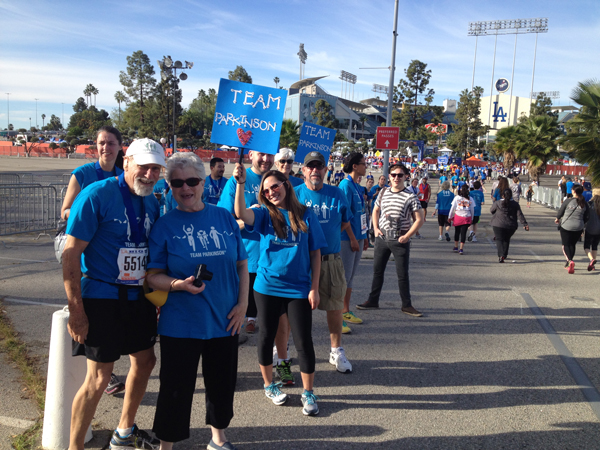
John and Edna Ball (front left)
Edna Ball of Team Parkinson, shares with us her connection with Parkinson’s disease and how important team fundraising efforts are for the future
Q: What’s your connection to Parkinson’s disease (PD)?
A: When I was a girl of just 11-years old, my mother was diagnosed with PD at the age of 48. This was in 1961 in Montreal, Canada. At the time there weren’t even any medications for the disease. That came a few years later and by then we had already moved to Los Angeles. My mother’s PD progression was fairly slow. Then in 1973 I married John, and just before our 10th anniversary in 1983, he was also diagnosed with PD, although he’d had symptoms that went undiagnosed for 12 years. My Mom lived with PD for 37-years, the last few proving to be very difficult for her, as well as for the family as we struggled to cope with her deterioration. She passed away at the age of 85 in 1998. And now 18 years later we’re still looking for a cure.
Q: How is it that you came to work for over 15 years now in the PD community to raise awareness and funds for research.
A: The fact that my Mom struggled so much with PD and that John might be facing a similar future, was disturbing. Then in 1999, through some people we knew in the PD community, the opportunity arose to enter the official charity program of the Los Angeles Marathon, a race that grew out of the 1984 Olympics held here in L.A. With the backing and support of The Parkinson Alliance, Team Parkinson was formed and was accepted as one of the official charities of the race. Our mission was to raise awareness, empower people with PD to improve the quality of their lives through exercise, and to raise funds for scientific research towards a cure. I certainly had a deep vested interest in making that last goal a reality. It may have been too late for my Mom, but there was still time to hopefully help John and so many others.
Q: Has Team Parkinson been able to fulfill its mission?
A: Absolutely! In the nearly 16 years since we started, we’ve most definitely raised awareness through our visibility at Expos, races, support groups and conferences. And we’ve also had so many people get inspired and excited to either walk or run in marathons, half-marathons and 5Ks. It’s been incredibly rewarding to know that we’ve helped contribute to better health and quality of life for so many. John himself has been the catalyst by having run 25 marathons, many half-marathons, 5 and 10Ks, and an ultra-marathon! As to the last drive of the mission statement, we’re extremely proud to have raised close to 3 million dollars for research.
Q: How much progress has there been in the field of research over all these years?
A: There has actually been quite a lot of progress and there is now more hope than ever before that we’re closer to the answer that is this puzzle called Parkinson’s. When John speaks at support groups now he tells new patients that they’re lucky to have been diagnosed now because there is so much active and innovative research going on globally that will impact PD significantly, either with a cure, a slowing of the progression of the disease, the ability to detect PD early on and the ability to improve delivery of drugs that will enhance quality of life. It’s an exciting time that demands our attention and our dollars.
Q: What do you mean by “demands our attention?”
A: I mean that it’s imperative that these research projects that show real promise for helping people with PD get significant funding so that the work can continue. There is no shortage of disease groups all vying for the same dollars from the National Institutes of Health. So it’s very important that we work really hard to find the money for Parkinson’s disease research to be adequately funded. Team Parkinson has been a great way to engage people in that drive for funding.
Q: How does Team Parkinson campaign for funds?
A: Right now our campaign is our participation in the LA Marathon events. So basically we ask those participating in the races to let all their family and friends know what they’re doing and how important it is for their futures. Running or walking in these events is not an easy task, but it shows the commitment of these participants to want to do something positive to ensure a better future for themselves and their children and grandchildren. In other, they want this disease gone, and they understand that research is the answer. So they raise money and do it passionately.
Q: Which race are you participating in on Valentine’s weekend?
A: Health permitting, I’m hoping to walk the 5K. And John will be running the first half of the 2-Person Charity Relay…that’s 13.1 miles! It takes a lot of training and it’s a lot of work, but we have such a clear understanding of how important this is and we try to convey that to our participants. And those walking or running with PD are truly inspiring and should be supported in their efforts.
Q: What do you love most about being part of this team?
A: I think what I love most is the spirit of these amazing people with PD taking on this challenge and taking it personally to show the world that they may have PD but it doesn’t have them. Some run, some walk slowly, some with walkers and some in wheelchairs pushed by loved ones. Not a year has gone by since our first race in 2000 that I don’t tear up at the finish line as I see people so bravely crossing that line to get their medals. It’s pretty inspiring!
Q: With the race just a week away why is a final fundraising push so important?
A: I like to think that the fundraising effort should match the training effort in intensity. Our PD participants should toot their own horns and let family and friends know how hard they’ve worked, how proud they are of this accomplishment and how important their fundraising effort is for the future.
Q: What fundraising tips can you give people?
A: The one I always start with is to let those people I ask for money feel and know that I’m giving them a great opportunity to do something really good and really important. And that’s very much the simple truth. I encourage people to ask everyone they know … family, friends, business associates, their own doctors, dentists, etc. They should stress that what they’re doing isn’t easy and they would love support through generous contributions.
Another fun way to ask for donations is to take selfies as they’re training and proudly show family and friends that they’re really out there putting in the miles. Send those photos through e-mail, Facebook or Twitter to make an impact. It takes a lot of work to do this and it takes a lot of money to continue the work of research.
Along the same line, it’s very cool to take a picture at the finish line proudly wearing your medal. That medal is affirmation of everything you’ve worked for to get to this point. And the fundraising you do, and the dollars you bring in for research, are also affirmation of the importance of your journey with PD. It’s a great idea to send those post-race photos out as a thank you to those that have contributed and as an additional push to those who have not yet done so. You should definitely be proud of yourself. So let others know that they too can express their pride through a generous donation to Team Parkinson.
To register/donate and learn more about Team Parkinson, please visit www.team-parkinson.org.